Sule Pagoda
Key Notion: roundabouts and protest religious site repurposed
Built: 5th century BC
Date of Incident: 1988
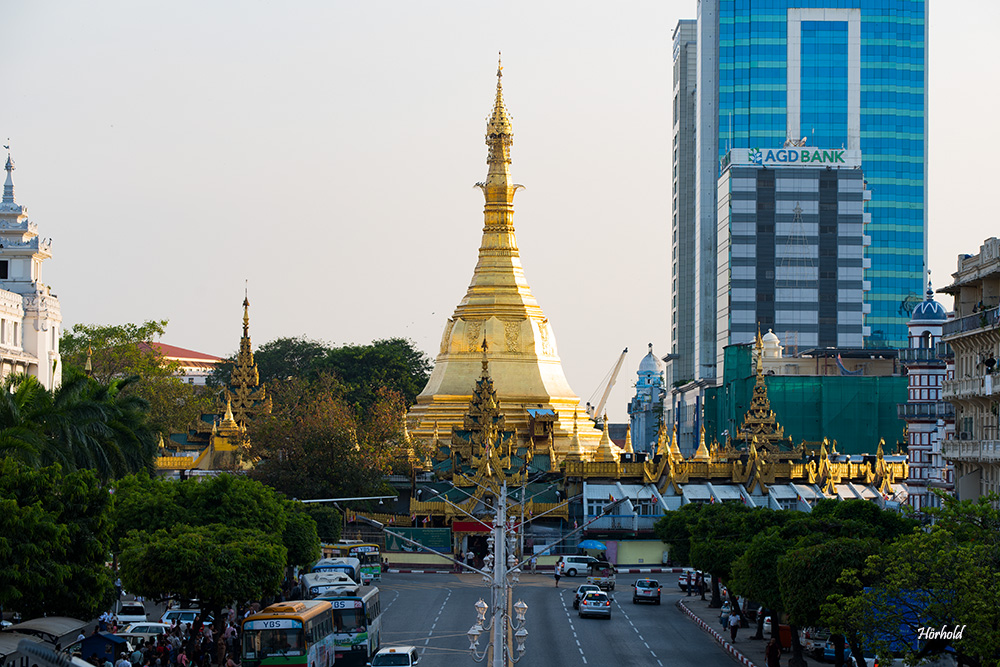
Roundabouts The Sule Pagoda is in the Downtown of Yangon and was approximately built in 5th century BC. After the Second Anglo-Burmese War in 1852, the British set out to develop Rangoon’s port. Although to many Burmese, the Shwedagon Pya was the heart and center of the town, the British (Lieutenant Fraser of the Bengal Engineers) picked up the Sule Pagoda to be the heart of the town’s new street grid. Up to a change of the street name it was even called the Fraser Street until it was changed to Anawratha Road. In 1880, during the colonial era, the Sule Pagoda, as the representative centerpiece of the Biritsh Burmese realm, underwent extensive renovation; little original structure remains. This puts into perspective the vast challenges posed by some Yangon’s large colonial constructions. At that time, the Sule Pagoda stood on an island on the swampy banks of Yangon River, connected to the town by a small wooden bridge. The British drained the shores and established Downtown Yangon as we know it. Unlike the Shwedagon Pya, the Sule Pya has not much changed since its ancient time. Today, a ring of modern construction surrounds it. And far from an oasis of calm, the place is a scramble of shoulders an elbows, chanting and conversation. Meanwhile, Yangon’s increasingly dense traffic grinds its way along the roundabout at its feet.